Year
2025
Client
nebula.io
Category
Full-Stack Development
Product Duration
3 - 4 months
Crypto payment infrastructure is fragmented, insecure, and developer-hostile. Businesses either rely on custodial wallets, use legacy processors with limited chain support, or build everything from scratch. Nebula was built to close that gap a non-custodial, multi-chain payment API with a Stripe-calibre developer experience.
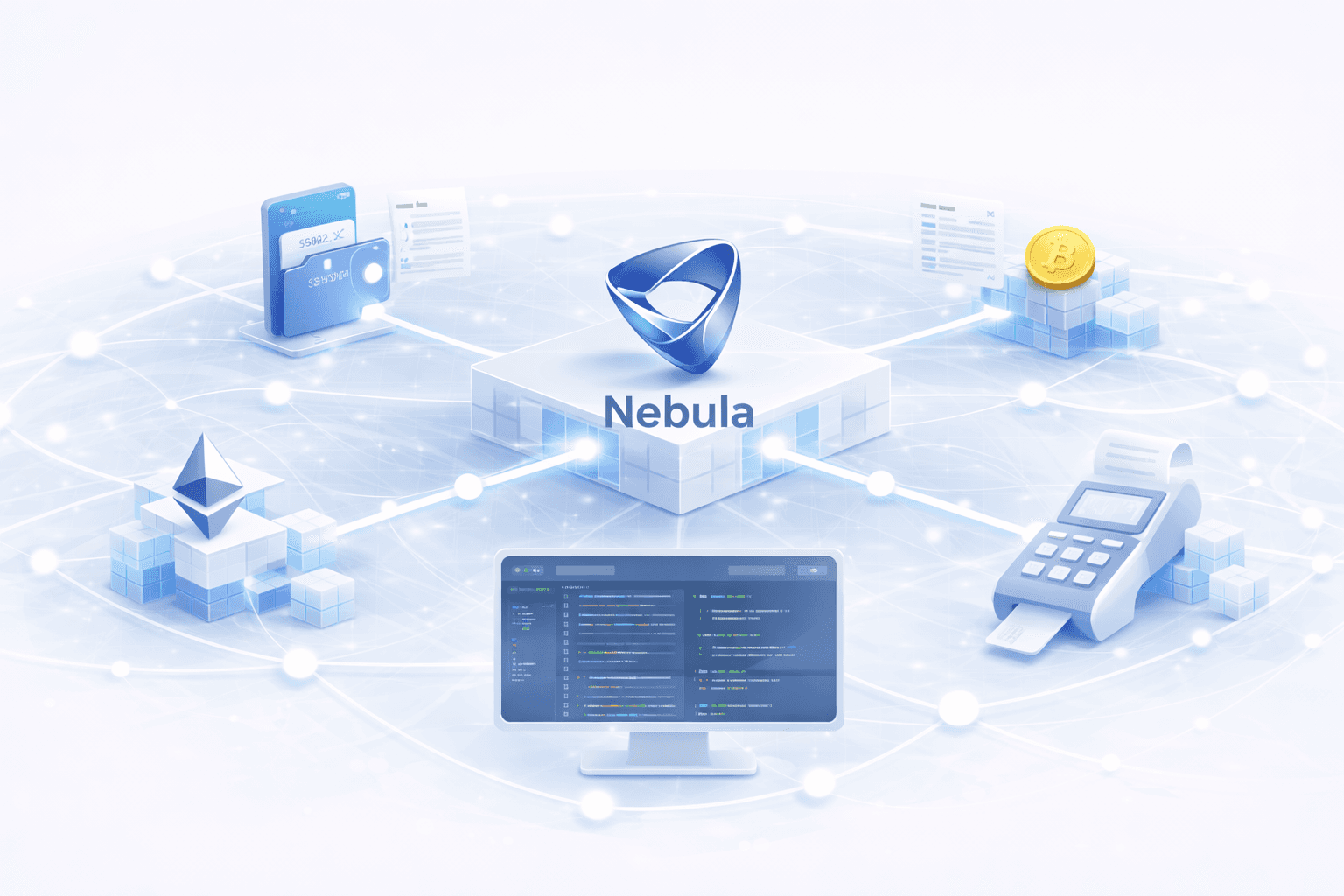
Nebula is a distributed full-stack system built across Next.js 14, Node/Express, MongoDB, Redis, and Ethers.js. The backend runs 46 API endpoints across three auth layers, 16 MongoDB collections with 45+ indexes, and 5 Bull queue workers running 24/7, handling payment detection, confirmation tracking, webhook delivery, session expiry, and analytics aggregation.

Custom background workers poll Ethereum, Polygon, Base, Arbitrum, and Sepolia testnet every 15 seconds using Ethers.js. Payments move automatically from pending → confirming → succeeded based on block depth. Native ETH and ERC-20 tokens (USDC, USDT) are supported. API response time sits under 200ms, with payment detection latency between 15–30 seconds.

Nebula is designed the way Stripe is designed, test/live mode isolation, HMAC-signed webhooks with exponential backoff retry, API key management, real-time payment logs, and white-label checkout branding. Security was built in from day one: bcrypt-hashed keys, input validation on every endpoint, rate limiting, and secrets redacted from all logs. Launching to Vercel shortly, built and hosted locally since December 2025.

Security was never an afterthought on Nebula, it was foundational. API keys are hashed with bcrypt and never stored in plaintext. Every webhook payload is signed with HMAC-SHA256, giving merchants cryptographic proof of delivery. Rate limiting caps requests at 100 per 15-minute window per merchant, and express-validator runs input sanitization on every single endpoint. Test and live environments are fully isolated, no production data contamination, ever.

Nebula's analytics layer tracks payment volume over time, breakdowns by chain, breakdowns by token, and custom merchant metrics all Redis-cached with a 1-hour TTL and updated asynchronously by a background aggregation worker. The result: analytics endpoints respond in under 150ms with an ~80% cache hit rate. The system is built to stay fast under load without hitting the database on every request.

Nebula runs on a three-tier SaaS model : Starter (free, 2% per transaction), Growth ($49/month, 1%), and Enterprise ($299/month, 0.5%). What makes it crypto-native: subscription fees are paid in USDC through Nebula's own checkout rails. No Stripe. No banks. The long-term vision is simple: become the default crypto payment infrastructure for the internet, the same way Stripe became default for card payments.

Built entirely solo from December 2025, every architectural decision, every trade-off, every line of code. The platform spans ~5,000 lines of new code across 30+ files, 46 REST API endpoints, 16 database collections, 5 background workers, and 5 blockchain networks. Frontend-to-backend wiring is the final step before Vercel launch. What started as a solo engineering challenge became a production-grade distributed system with real commercial potential.